

Wealth Daily
Asia's chip rally meets a renewed oil shock
Today’s Must-Know News
Overnight Markets
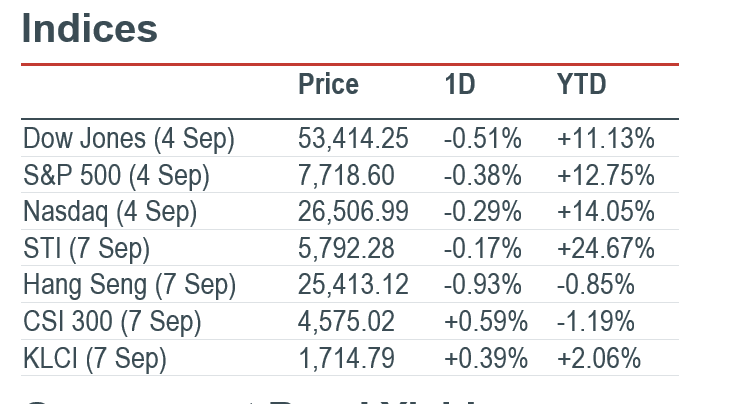
Market Movers: Asian equities diverged sharply: South Korea's KOSPI surged 4.61% and Japan's Nikkei 2.12% as chip shares rallied, while Hong Kong's Hang Seng fell 0.93%. Singapore's STI eased 0.17%, Malaysa's KLCI gained 0.39% and Europe's STOXX 600 closed flat. US cash markets were closed for Labor Day. (AP, Reuters, Business Times, The Star)
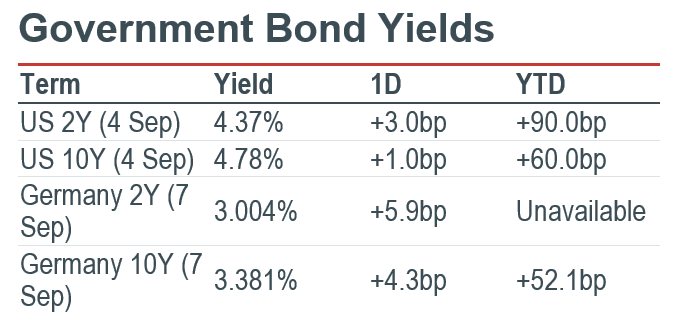
Macro: The 162,000 August US payroll gain remained the global rate anchor, lifting the market-implied chance of a rate hike on 16 September FOMC to about 60%. The ECB is expected to raise rates by 25bp on Thursday; stronger euro-area growth and sentiment data reinforced that case. US PPI on Thursday and CPI on Friday will test whether the oil shock is broadening. (Reuters, BLS, ECB)
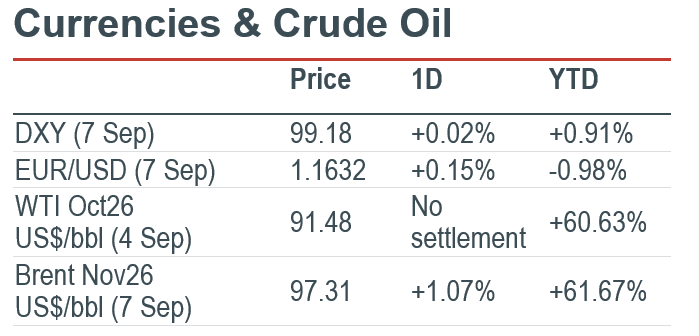
FICC: Brent settled 1.1% higher at US$97.31 after touching US$98.06 as US-Iran attacks and Tehran's planned restricted zone near Hormuz intensified supply risk. WTI had no official holiday settlement. The dollar index saw little change at 99.18, while the yen strengthened to 154.32 per US dollar. Tencent Holdings (0700.HK) and Alibaba Group (9988.HK) are our Core Recommendations. (Reuters)


Americas
U.S. markets pause for Labor Day. NYSE markets were closed on 7 September, so the Dow, S&P 500 and Nasdaq entries retain their completed 4 September closes. The lack of a fresh US equity close matters: Monday's global repricing happened through oil, currencies and non-US markets rather than a new Wall Street cash signal. (NYSE)
Strong jobs keep a September Fed increase live. Friday's 162,000 payroll gain continued to reverberate, with markets assigning roughly a 60% chance to a 25bp rate increase on 16 September FOMC. That is background rather than a new release, but it explains why higher oil prices translated quickly into renewed inflation and duration concerns. (Reuters)
Brent settles at a six-week high. November Brent gained US$1.03, or 1.1%, to US$97.31 after reaching US$98.06. WTI was US$92.65 in holiday trading but did not settle. The trigger was renewed US-Iran attacks around shipping and Iran's planned restricted zone outside Hormuz, keeping a geopolitical premium embedded in energy. (Reuters)
Inflation releases become the next decision points. The BLS calendar places August PPI at 20:30 SGT on Thursday and CPI at 20:30 SGT on Friday. With cash equities closed Monday, these releases are the next clean US tests of whether energy pressure is feeding broader prices and whether current Fed hike odds are durable. (BLS)
Greater China
Hong Kong falls as mainland large caps edge higher. The Hang Seng lost 237.75 points, or 0.93%, to 25,413.12; the HSCEI fell 1.5% and the Hang Seng Tech Index fell 0.9%. By contrast, the CSI 300 gained 0.59% to 4,575.02 and the Shanghai Composite added 0.06%. The split shows more resilient onshore breadth than the offshore technology tape. (ETNet / Reuters)
Tencent and Alibaba retreat below resistance. Tencent closed at HK$438.40, down 0.99%, while Alibaba eased 0.45% to HK$109.60. Tencent remains below its recalculated 20- and 50-day averages; Alibaba is also below both trend measures. Both remain Core Recommendations, but the technical setup argues for confirmation above HK$447.60 and HK$111.90, respectively. (ETNet / Yahoo Finance)
Baidu enters southbound Stock Connect eligibility. Baidu's Class A Hong Kong shares became eligible for Shanghai-Hong Kong Stock Connect trading on 7 September. The change broadens direct access for mainland investors; the investable effect will depend on sustained flows rather than eligibility alone. (Baidu / SEC)
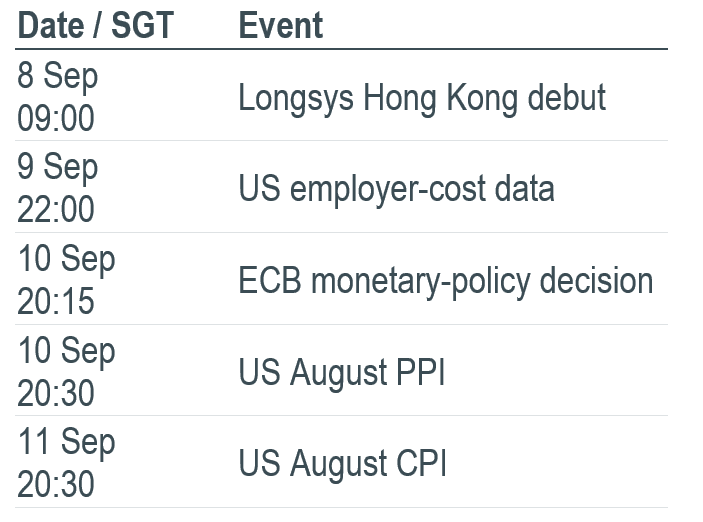
Two technology IPOs define the near-term calendar. Memory-chip company Longsys is due to begin trading on 8 September after publishing its allotment result, while Excelland Robot is scheduled for 9 September. Both sit near the current AI-hardware theme, but first-day liquidity and price discovery remain the immediate risks. (HKEX)
Asia ex. China
Korea and Japan lead a semiconductor rally. The KOSPI surged 4.61% to 6,995.39 and the Nikkei gained 2.12% to 66,399.84. Samsung Electronics rose 5.7%, SK Hynix 8.1% and Tokyo Electron 4.7%. The move extended Friday's US chip strength, but richer valuations leave the group sensitive to yields and earnings delivery. (AP)
Singapore slips as banks outweigh selective winners. The STI fell 9.68 points, or 0.17%, to 5,792.28. DBS lost 0.2% to S$78.47, OCBC 1.2% to S$31.88 and UOB 0.6% to S$41.75. Sats rose 2.3% to S$3.97, while DFI Retail fell 1.4% to US$3.57; gainers narrowly exceeded losers. (Business Times)
Malaysia advances on concentrated blue-chip demand. The KLCI gained 6.69 points, or 0.39%, to 1,714.79, led by banking and utility heavyweights. PETRONAS Gas rose to RM17.70 and Tenaga to RM13.84, yet losers outnumbered gainers 610 to 488. The divergence suggests index support was narrower than the headline gain. (The Star)
Oil raises the bar for regional central banks. The combination of resilient US employment and Brent near US$100 strengthens the higher-for-longer case across Asia. Japan's yen rally reflected expectations that the Bank of Japan could move again, while emerging markets must balance energy-import costs against still-uneven domestic demand. (Reuters)
EMEA and Others
European equities finish flat as energy offsets defensives. The STOXX 600 ended at 649.9, effectively unchanged. Energy gained 1.2%, while Switzerland fell 0.8% and Germany's DAX lost 0.2%. Stronger oil supported producers but raised the discount rate applied to longer-duration equities. (Reuters)
The ECB decision is the week's central catalyst. The ECB publishes its decision at 20:15 SGT on Thursday, followed by a 20:45 SGT press conference. Markets and economists widely expect a 25bp increase. The key risk is guidance: another December move is increasingly debated as energy complicates the inflation path. (ECB / Reuters)
Growth data reduce the case for patience. Euro-area second-quarter GDP was revised to 0.6% quarter on quarter and 1.2% year on year, both above expectations, while September investor morale reached a more than four-year high. Better activity gives the ECB more scope to respond to energy-driven inflation. (Reuters)
Novartis drops after a cardiovascular study miss. Novartis fell 3.2% after pelacarsen failed to reduce heart attacks and strokes in a closely watched study. The move shows how binary late-stage outcomes can override a supportive sector backdrop; follow-up scrutiny now shifts to subgroup evidence and pipeline replacement. (Reuters)
IQE turns profitable as AI-photonics demand builds. IQE reported adjusted first-half core profit of GBP6 million versus a GBP0.4 million loss a year earlier and maintained its annual outlook. Demand for data-centre photonics supported the improvement, although indium-phosphide substrate bottlenecks remain an execution risk. (Reuters)
Traders' Corner
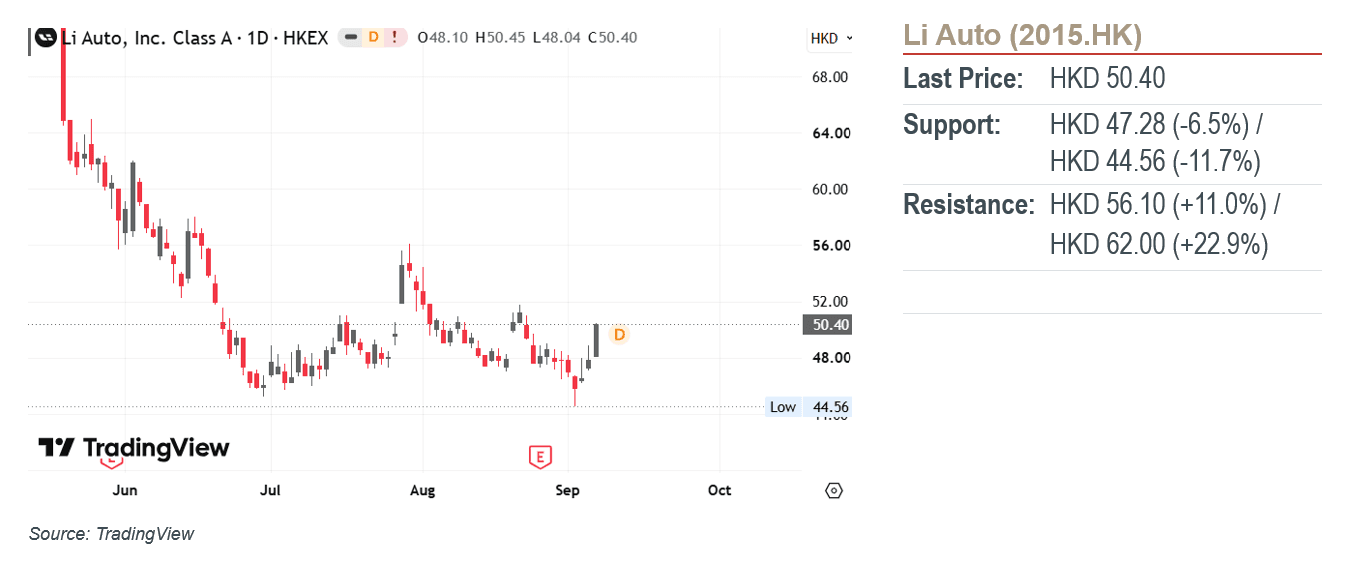
Price indicates potential major bottoming behavior following a successful rebound off its previous low support boundary.
A bullish RSI divergence has developed while the oscillator holds securely above its neutral 50-midline.
This structural momentum alignment signals that downside sell-side pressure has exhausted.
A decisive penetration above the HK$51.80 swing resistance pivot—followed by the validation of a higher low—will complete a classic structural trend reversal, confirming a shift in market bias and unlocking further upside expansion toward higher primary target levels.
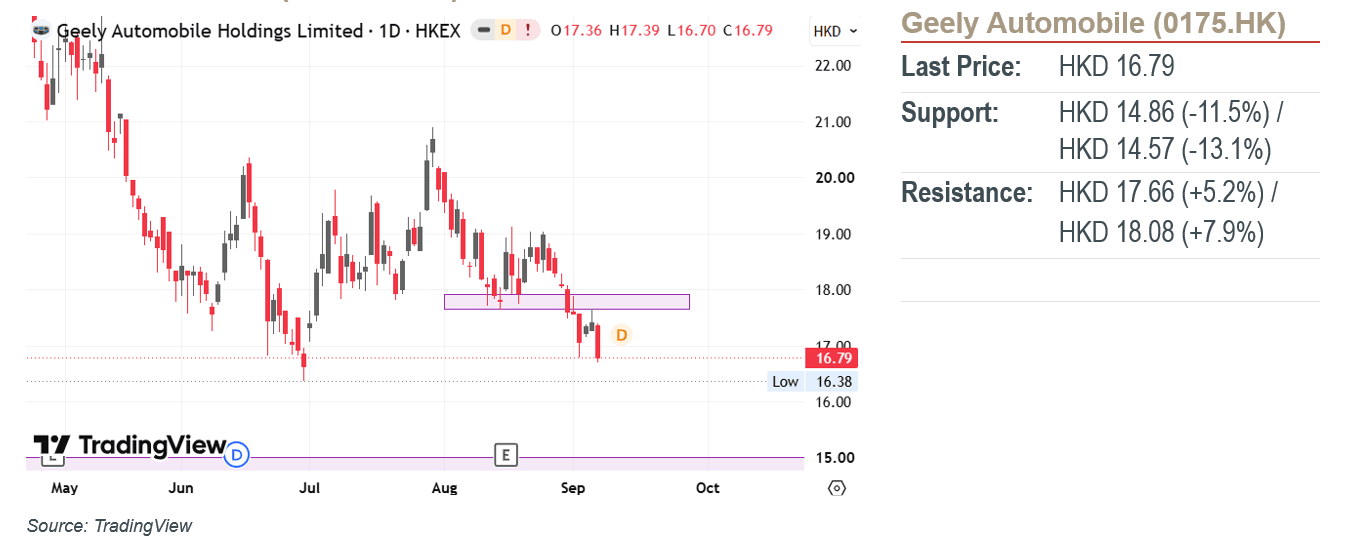
Price experienced a sharp rejection at its support-turned-resistance zone, marked by a shooting star candlestick pattern and validated by immediate bearish follow-through.
Technical momentum reinforces this breakdown, as the RSI drops cleanly below its neutral 50-midline to signal expanding downside acceleration.
As long as intraday retests remain capped below this converted resistance ceiling, path-of-least-resistance dynamics favours a continued downside drift toward lower primary support targets.
Market Movers: Asian equities diverged sharply: South Korea's KOSPI surged 4.61% and Japan's Nikkei 2.12% as chip shares rallied, while Hong Kong's Hang Seng fell 0.93%. Singapore's STI eased 0.17%, Malaysa's KLCI gained 0.39% and Europe's STOXX 600 closed flat. US cash markets were closed for Labor Day. (AP, Reuters, Business Times, The Star)
Macro: The 162,000 August US payroll gain remained the global rate anchor, lifting the market-implied chance of a rate hike on 16 September FOMC to about 60%. The ECB is expected to raise rates by 25bp on Thursday; stronger euro-area growth and sentiment data reinforced that case. US PPI on Thursday and CPI on Friday will test whether the oil shock is broadening. (Reuters, BLS, ECB)
FICC: Brent settled 1.1% higher at US$97.31 after touching US$98.06 as US-Iran attacks and Tehran's planned restricted zone near Hormuz intensified supply risk. WTI had no official holiday settlement. The dollar index saw little change at 99.18, while the yen strengthened to 154.32 per US dollar. Tencent Holdings (0700.HK) and Alibaba Group (9988.HK) are our Core Recommendations. (Reuters)
Americas
U.S. markets pause for Labor Day. NYSE markets were closed on 7 September, so the Dow, S&P 500 and Nasdaq entries retain their completed 4 September closes. The lack of a fresh US equity close matters: Monday's global repricing happened through oil, currencies and non-US markets rather than a new Wall Street cash signal. (NYSE)
Strong jobs keep a September Fed increase live. Friday's 162,000 payroll gain continued to reverberate, with markets assigning roughly a 60% chance to a 25bp rate increase on 16 September FOMC. That is background rather than a new release, but it explains why higher oil prices translated quickly into renewed inflation and duration concerns. (Reuters)
Brent settles at a six-week high. November Brent gained US$1.03, or 1.1%, to US$97.31 after reaching US$98.06. WTI was US$92.65 in holiday trading but did not settle. The trigger was renewed US-Iran attacks around shipping and Iran's planned restricted zone outside Hormuz, keeping a geopolitical premium embedded in energy. (Reuters)
Inflation releases become the next decision points. The BLS calendar places August PPI at 20:30 SGT on Thursday and CPI at 20:30 SGT on Friday. With cash equities closed Monday, these releases are the next clean US tests of whether energy pressure is feeding broader prices and whether current Fed hike odds are durable. (BLS)
Greater China
Hong Kong falls as mainland large caps edge higher. The Hang Seng lost 237.75 points, or 0.93%, to 25,413.12; the HSCEI fell 1.5% and the Hang Seng Tech Index fell 0.9%. By contrast, the CSI 300 gained 0.59% to 4,575.02 and the Shanghai Composite added 0.06%. The split shows more resilient onshore breadth than the offshore technology tape. (ETNet / Reuters)
Tencent and Alibaba retreat below resistance. Tencent closed at HK$438.40, down 0.99%, while Alibaba eased 0.45% to HK$109.60. Tencent remains below its recalculated 20- and 50-day averages; Alibaba is also below both trend measures. Both remain Core Recommendations, but the technical setup argues for confirmation above HK$447.60 and HK$111.90, respectively. (ETNet / Yahoo Finance)
Baidu enters southbound Stock Connect eligibility. Baidu's Class A Hong Kong shares became eligible for Shanghai-Hong Kong Stock Connect trading on 7 September. The change broadens direct access for mainland investors; the investable effect will depend on sustained flows rather than eligibility alone. (Baidu / SEC)
Two technology IPOs define the near-term calendar. Memory-chip company Longsys is due to begin trading on 8 September after publishing its allotment result, while Excelland Robot is scheduled for 9 September. Both sit near the current AI-hardware theme, but first-day liquidity and price discovery remain the immediate risks. (HKEX)
Asia ex. China
Korea and Japan lead a semiconductor rally. The KOSPI surged 4.61% to 6,995.39 and the Nikkei gained 2.12% to 66,399.84. Samsung Electronics rose 5.7%, SK Hynix 8.1% and Tokyo Electron 4.7%. The move extended Friday's US chip strength, but richer valuations leave the group sensitive to yields and earnings delivery. (AP)
Singapore slips as banks outweigh selective winners. The STI fell 9.68 points, or 0.17%, to 5,792.28. DBS lost 0.2% to S$78.47, OCBC 1.2% to S$31.88 and UOB 0.6% to S$41.75. Sats rose 2.3% to S$3.97, while DFI Retail fell 1.4% to US$3.57; gainers narrowly exceeded losers. (Business Times)
Malaysia advances on concentrated blue-chip demand. The KLCI gained 6.69 points, or 0.39%, to 1,714.79, led by banking and utility heavyweights. PETRONAS Gas rose to RM17.70 and Tenaga to RM13.84, yet losers outnumbered gainers 610 to 488. The divergence suggests index support was narrower than the headline gain. (The Star)
Oil raises the bar for regional central banks. The combination of resilient US employment and Brent near US$100 strengthens the higher-for-longer case across Asia. Japan's yen rally reflected expectations that the Bank of Japan could move again, while emerging markets must balance energy-import costs against still-uneven domestic demand. (Reuters)
EMEA and Others
European equities finish flat as energy offsets defensives. The STOXX 600 ended at 649.9, effectively unchanged. Energy gained 1.2%, while Switzerland fell 0.8% and Germany's DAX lost 0.2%. Stronger oil supported producers but raised the discount rate applied to longer-duration equities. (Reuters)
The ECB decision is the week's central catalyst. The ECB publishes its decision at 20:15 SGT on Thursday, followed by a 20:45 SGT press conference. Markets and economists widely expect a 25bp increase. The key risk is guidance: another December move is increasingly debated as energy complicates the inflation path. (ECB / Reuters)
Growth data reduce the case for patience. Euro-area second-quarter GDP was revised to 0.6% quarter on quarter and 1.2% year on year, both above expectations, while September investor morale reached a more than four-year high. Better activity gives the ECB more scope to respond to energy-driven inflation. (Reuters)
Novartis drops after a cardiovascular study miss. Novartis fell 3.2% after pelacarsen failed to reduce heart attacks and strokes in a closely watched study. The move shows how binary late-stage outcomes can override a supportive sector backdrop; follow-up scrutiny now shifts to subgroup evidence and pipeline replacement. (Reuters)
IQE turns profitable as AI-photonics demand builds. IQE reported adjusted first-half core profit of GBP6 million versus a GBP0.4 million loss a year earlier and maintained its annual outlook. Demand for data-centre photonics supported the improvement, although indium-phosphide substrate bottlenecks remain an execution risk. (Reuters)
Traders' Corner
Price indicates potential major bottoming behavior following a successful rebound off its previous low support boundary.
A bullish RSI divergence has developed while the oscillator holds securely above its neutral 50-midline.
This structural momentum alignment signals that downside sell-side pressure has exhausted.
A decisive penetration above the HK$51.80 swing resistance pivot—followed by the validation of a higher low—will complete a classic structural trend reversal, confirming a shift in market bias and unlocking further upside expansion toward higher primary target levels.
Price experienced a sharp rejection at its support-turned-resistance zone, marked by a shooting star candlestick pattern and validated by immediate bearish follow-through.
Technical momentum reinforces this breakdown, as the RSI drops cleanly below its neutral 50-midline to signal expanding downside acceleration.
As long as intraday retests remain capped below this converted resistance ceiling, path-of-least-resistance dynamics favours a continued downside drift toward lower primary support targets.
Disclosures and disclaimers
This report is provided subject to, and must be read together with, the full Disclosures / Disclaimers available at this link, which are incorporated by reference into this report. In particular, this report is intended for general circulation and informational purposes only and does not constitute personal investment advice or a recommendation to buy or sell any investment product or security. You should independently evaluate the information and, where necessary, seek advice from a qualified financial adviser regarding the suitability of any investment. Analyst certifications required under applicable regulations, including SEC Regulation AC (where relevant), are included in this report. By accessing, receiving or using this report, you acknowledge that you have read, understood and agreed to be bound by the Disclosures / Disclaimers, as may be amended, supplemented or updated from time to time.


