

Periodic/Sector reports
IT Hardware: 2Q26 Results: With Sector-wide Shortages Now, Buy Execution Over Bottlenecks
OVERWEIGHT (Maintained)
Analyst
Analyst
Highlights
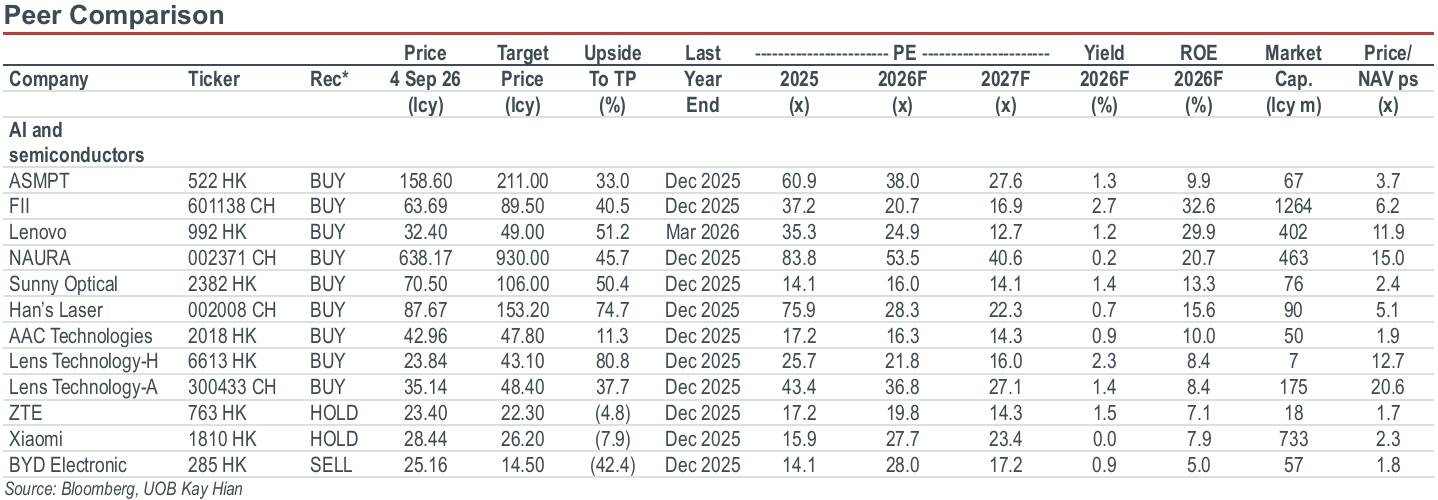
Results for the quarter ended Jun 26 were mixed across the sector. Export driven AI infrastructure players benefitted from sustained AI demand and capex expansion, while handset-exposed companies with significant exposure to low-end Android devices delivered weaker results as rising memory costs weighed on shipment volumes.
AI-related players are better positioned to pass on these costs amid strong inelastic AI demand, while consumer electronic players continue to face volume and margin pressure.
We prefer AI infrastructure and supply chain beneficiaries that face fewer supply constraints than bottleneck-driven names, including NVIDIA supply chain suppliers such as FII and domestic equipment leaders such as NAURA and Han's Laser. Maintain OVERWEIGHT.
Forex was a common theme this quarter, as renminbi appreciation led to foreign exchange losses across a number of export-oriented names.
Analysis
Hyperscaler AI spending continues to accelerate. Capex guidance for the top four hyperscalers has been revised upward by US$30b to around US$733b for 2026; and on the China side, Tencent and Baidu’s post-results capex estimates were raised by 18.1%/48.0% respectively, according to Bloomberg consensus. Overall, Trendforce now expects the top nine hyperscalers to spend a total of US$922b in 2026, representing a yoy growth of 98%, before growing another 50% yoy by 2027. The sustained elevation in cloud capex guidance/expectations is primarily driven by robust demand for AI compute, although the component price hikes are now playing a huge role as well, notably with memory price now expected to contribute 47% of 2026’s total AI capex, before further jumping to 68% by 2027, while other components, such as PCB, MLCC, CPU, GPU, are all seeing price hikes amid strong demand growth. As a result, NVIDIA’s Vera Rubin rack is expected to surge to >US$7m, vs around US$3.8m in Grace Blackwell (GB) racks.
Nevertheless, we believe that the fact that hyperscalers are still willing to pay for the price premium shows how inelastic AI demand is currently, and we expect the customers to employ more system or algorithm level optimisation to offset the hardware price hikes instead of slowing down investment plans in the near future.
Highlights
Results for the quarter ended Jun 26 were mixed across the sector. Export driven AI infrastructure players benefitted from sustained AI demand and capex expansion, while handset-exposed companies with significant exposure to low-end Android devices delivered weaker results as rising memory costs weighed on shipment volumes.
AI-related players are better positioned to pass on these costs amid strong inelastic AI demand, while consumer electronic players continue to face volume and margin pressure.
We prefer AI infrastructure and supply chain beneficiaries that face fewer supply constraints than bottleneck-driven names, including NVIDIA supply chain suppliers such as FII and domestic equipment leaders such as NAURA and Han's Laser. Maintain OVERWEIGHT.
Forex was a common theme this quarter, as renminbi appreciation led to foreign exchange losses across a number of export-oriented names.
Analysis
Hyperscaler AI spending continues to accelerate. Capex guidance for the top four hyperscalers has been revised upward by US$30b to around US$733b for 2026; and on the China side, Tencent and Baidu’s post-results capex estimates were raised by 18.1%/48.0% respectively, according to Bloomberg consensus. Overall, Trendforce now expects the top nine hyperscalers to spend a total of US$922b in 2026, representing a yoy growth of 98%, before growing another 50% yoy by 2027. The sustained elevation in cloud capex guidance/expectations is primarily driven by robust demand for AI compute, although the component price hikes are now playing a huge role as well, notably with memory price now expected to contribute 47% of 2026’s total AI capex, before further jumping to 68% by 2027, while other components, such as PCB, MLCC, CPU, GPU, are all seeing price hikes amid strong demand growth. As a result, NVIDIA’s Vera Rubin rack is expected to surge to >US$7m, vs around US$3.8m in Grace Blackwell (GB) racks.
Nevertheless, we believe that the fact that hyperscalers are still willing to pay for the price premium shows how inelastic AI demand is currently, and we expect the customers to employ more system or algorithm level optimisation to offset the hardware price hikes instead of slowing down investment plans in the near future.
OVERWEIGHT (Maintained)
Analyst
Analyst
IMPORTANT NOTICE - DISCLOSURES AND DISCLAIMERS
This report is provided subject to, and must be read together with, the full Disclosures / Disclaimers available at this link, which are incorporated by reference into this report. In particular, this report is intended for general circulation and informational purposes only and does not constitute personal investment advice or a recommendation to buy or sell any investment product or security. You should independently evaluate the information and, where necessary, seek advice from a qualified financial adviser regarding the suitability of any investment. Analyst certifications required under applicable regulations, including SEC Regulation AC (where relevant), are included in this report. By accessing, receiving or using this report, you acknowledge that you have read, understood and agreed to be bound by the Disclosures / Disclaimers, as may be amended, supplemented or updated from time to time.
Related articles

4 Sept 2026
Internet - 2Q26 Results Recap: AI Cloud Accelerates; E-Commerce Still Soft; Gaming Resilient

3 Sept 2026
Internet: AI Capex: Returns Remain Attractive, Funding Risk Diverging

4 Sept 2026
Automobile - Weekly: 2Q26 Results Review And 2H26 Outlook
Our latest research

8 Sept 2026
China Healthcare: Innovation And Globalisation: The Twin Engines For Growth

8 Sept 2026
China Property: Shanghai Shifts Housing Supply From New Build To Renewal; National Land Supply Keeps Shrinking
4 Sept 2026