

Company Coverage
Japfa Comfeed Indonesia (JPFA IJ): Solid 2Q26, Albeit Lower qoq On Seasonality
BUY (Maintained)
Current price:
Target price:
Upside:
Rp2,080
Rp3,330
+60.1%
Analyst
Analyst
Highlights
- Expect JPFA to post solid 2Q26 results, despite being lower seasonally qoq.
- Its structural growth story remains intact, supported by healthier industry dynamics, JPFA's position as an integrated low-cost producer, and continued downstream expansion.
- Maintain BUY with a target price of Rp3,330, based on 8x 2026F PE.
Analysis
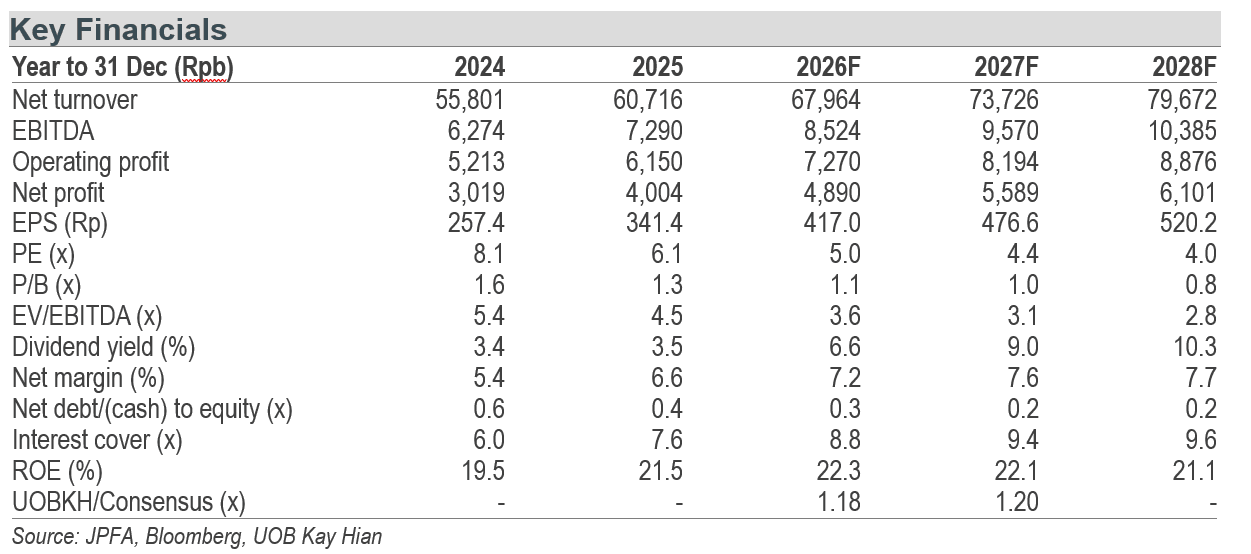
- Expect another solid quarter, despite being softer seasonally qoq. Following a record-high 1Q26 net profit of Rp1.8t (+14% qoq, +166% yoy), we expect 2Q26 earnings to moderate on a quarterly basis due to normal seasonality after Lebaran and the Suro month in June, but to remain stronger yoy (2Q25 net profit was Rp553b). Average livebird prices have declined to Rp18,681/kg (-15.3% qoq) but are 14.4% higher on a yoy basis. Margins should be slightly down on higher soybean meal (SBM), corn, and a weaker rupiah. However, concerns over SBM procurement centralisation following Berdikari's involvement appear less warranted, as JPFA continues to procure SBM independently and the associated margin impact should be limited. Overall, we forecast 2026 net profit of Rp4.89t (+22.1% yoy). 2Q26 results are undergoing a limited review and will be released on 31 Aug 26 at the latest.
- Government policy turning more constructive on poultry prices. We see the government becoming more supportive of maintaining healthy livebird prices, particularly following state-owned Berdikari's increased involvement in the sector. Notably, after livebird prices fell to Rp15,000-16,000/kg in May, the government intervened by requiring major poultry producers and industry associations to sign a joint commitment on 29 June to accelerate livebird absorption and gradually raise farmgate prices to a minimum of Rp19,500/kg. By 9 July, our checks indicated prices had recovered to around Rp19,000/kg. Even if livebird prices soften, JPFA's industry-leading cost position (around Rp19,000-20,000/kg vs the industry average of Rp21,000–23,000/kg) should allow it to remain more resilient than its peers. Its integrated business model and growing downstream contribution should also support more stable margins and reduce earnings volatility going forward.
- Remains optimistic on long-term outlook. The company targets to double its revenue within five years (~15% CAGR), with the downstream segment as the key growth driver and the Free Meal Program (MBG) providing incremental upside. JPFA will also continue to expand its production capacity, with 2026 capex budgeted at Rp2.2t–2.5t, similar as last year.
Highlights
- Expect JPFA to post solid 2Q26 results, despite being lower seasonally qoq.
- Its structural growth story remains intact, supported by healthier industry dynamics, JPFA's position as an integrated low-cost producer, and continued downstream expansion.
- Maintain BUY with a target price of Rp3,330, based on 8x 2026F PE.
Analysis
- Expect another solid quarter, despite being softer seasonally qoq. Following a record-high 1Q26 net profit of Rp1.8t (+14% qoq, +166% yoy), we expect 2Q26 earnings to moderate on a quarterly basis due to normal seasonality after Lebaran and the Suro month in June, but to remain stronger yoy (2Q25 net profit was Rp553b). Average livebird prices have declined to Rp18,681/kg (-15.3% qoq) but are 14.4% higher on a yoy basis. Margins should be slightly down on higher soybean meal (SBM), corn, and a weaker rupiah. However, concerns over SBM procurement centralisation following Berdikari's involvement appear less warranted, as JPFA continues to procure SBM independently and the associated margin impact should be limited. Overall, we forecast 2026 net profit of Rp4.89t (+22.1% yoy). 2Q26 results are undergoing a limited review and will be released on 31 Aug 26 at the latest.
- Government policy turning more constructive on poultry prices. We see the government becoming more supportive of maintaining healthy livebird prices, particularly following state-owned Berdikari's increased involvement in the sector. Notably, after livebird prices fell to Rp15,000-16,000/kg in May, the government intervened by requiring major poultry producers and industry associations to sign a joint commitment on 29 June to accelerate livebird absorption and gradually raise farmgate prices to a minimum of Rp19,500/kg. By 9 July, our checks indicated prices had recovered to around Rp19,000/kg. Even if livebird prices soften, JPFA's industry-leading cost position (around Rp19,000-20,000/kg vs the industry average of Rp21,000–23,000/kg) should allow it to remain more resilient than its peers. Its integrated business model and growing downstream contribution should also support more stable margins and reduce earnings volatility going forward.
- Remains optimistic on long-term outlook. The company targets to double its revenue within five years (~15% CAGR), with the downstream segment as the key growth driver and the Free Meal Program (MBG) providing incremental upside. JPFA will also continue to expand its production capacity, with 2026 capex budgeted at Rp2.2t–2.5t, similar as last year.
BUY (Maintained)
Current price:
Target price:
Upside:
Rp2,080
Rp3,330
+60.1%
Analyst
Analyst
IMPORTANT NOTICE - DISCLOSURES AND DISCLAIMERS
This report is provided subject to, and must be read together with, the full Disclosures / Disclaimers available at the following link: https://research-api.uobkayhian.com/assets/disclaimer/df64a6ea-7980-447c-ae9e-fd19b93257dc, which are incorporated by reference into this report. In particular, this report is intended for general circulation and informational purposes only and does not constitute personal investment advice or a recommendation to buy or sell any investment product or security. You should independently evaluate the information and, where necessary, seek advice from a qualified financial adviser regarding the suitability of any investment. Analyst certifications required under applicable regulations, including SEC Regulation AC (where relevant), are included in this report. By accessing, receiving or using this report, you acknowledge that you have read, understood and agreed to be bound by the Disclosures / Disclaimers, as may be amended, supplemented or updated from time to time.


